What Is Sound Insulating Rock Wool Used For?
Sound-Insulating Rock Wool is widely used to control unwanted noise in residential, commercial, and industrial buildings. Its dense, fibrous structure helps absorb airborne sound as it moves through walls, ceilings, and floors. In practical projects, installers place it between timber or metal studs, beneath suspended ceilings, or inside partition systems. It can soften conversations, footsteps, machinery noise, and the hollow echo of large rooms. Offices, cinemas, music rooms, apartment buildings, and mechanical enclosures often benefit from this application.
The material is not a complete soundproofing solution. That point matters. Effective acoustic performance depends on the entire assembly, including wall thickness, air gaps, boards, seals, and structural connections. Experienced contractors usually combine rock wool with resilient channels, acoustic plasterboard, or floating floors. They also check tested ratings, such as Sound Transmission Class or equivalent regional standards, rather than relying on thickness alone. A 50-millimeter panel may perform differently from another product with the same size. Installation errors can leave small gaps around sockets, pipes, and doors, allowing noise to pass easily. Even a carefully selected product may disappoint in a poorly sealed wall. Therefore, project designers should review manufacturer data, fire classifications, moisture conditions, and local building requirements. Results vary. That deserves honest attention. Sound-Insulating Rock Wool is valuable because it supports a layered acoustic strategy, not because it promises silence by itself. When specified and installed correctly, it can make a room feel calmer, clearer, and more private.
What Acoustic Properties Make Rock Wool Effective for Sound Insulation?
What Is Sound Insulating Rock Wool Used For?
Sound insulating rock wool works because its open, fibrous structure traps moving air and weakens sound energy. When sound waves enter the fibers, friction converts part of that energy into small amounts of heat. This process helps reduce airborne noise from voices, traffic, machinery, and music.
Its acoustic performance depends on more than density alone. Thickness, airflow resistance, installation quality, and the surrounding wall system all matter. A thicker layer usually absorbs lower frequencies more effectively, while a well-fitted cavity layer reduces sound transmission through walls and ceilings. Rock wool can also improve reverberation control in offices, studios, plant rooms, and residential spaces.
Gaps can ruin good materials.
During installation, the insulation should fill the cavity without being tightly compressed. Compression may reduce its designed thickness and limit acoustic performance. Sealed joints, resilient channels, and separated wall layers often matter just as much as the insulation itself. The material absorbs sound; it does not completely block every vibration.
That distinction is easy to miss. A poorly sealed door or rigid structural connection can still carry noise around an insulated wall. In practice, the best results come from treating the entire assembly, not relying on one product. Testing conditions also vary, so laboratory ratings should be interpreted carefully before applying them to a real building.
How Do NRC Ratings of 0.75–1.00 Measure Rock Wool’s Absorption?
Sound insulating rock wool is used in walls, ceilings, floors, and equipment enclosures to control unwanted noise. Its open, fibrous structure converts part of airborne sound energy into small amounts of heat. It does not block every sound by itself. Mass, airtightness, framing, and installation still matter.
NRC means Noise Reduction Coefficient. Under ASTM C423, laboratories calculate it from absorption measurements at 250, 500, 1,000, and 2,000 Hz. A reported NRC of 0.75 suggests strong average absorption, while 1.00 indicates very high absorption across those test frequencies. The 2023 ASHRAE Handbook explains that porous absorbers usually perform better at mid and high frequencies. A 50–100 mm rock wool panel can therefore reduce speech reflections, machinery noise, and harsh reverberation in practical rooms. Thicker material usually improves low-frequency absorption, but mounting gaps can also change results.
The test matters.
ISO 354 measures sound absorption in a reverberation room, not sound transmission through a complete wall. This distinction is often missed. A ceiling panel with NRC 0.90 may make a workshop sound calmer, yet it cannot replace a sealed, layered partition. Field performance can fall when installers compress the fibers, leave edge gaps, or ignore flanking paths around doors and ducts. I have seen drawings promise excellent acoustic control, while one unsealed service opening weakened the entire assembly. Ratings are useful evidence, not a guarantee.
Which Rock Wool Densities, from 40–120 kg/m³, Suit Different Uses?
What Is Sound Insulating Rock Wool Used For?
Sound insulating rock wool is used inside walls, ceilings, floors, and mechanical rooms to reduce airborne noise. It absorbs sound energy within its open fiber structure. The result can be quieter conversations, less traffic noise, and reduced equipment vibration. Density matters, but it is not the only decision.
Rock wool at 40–60 kg/m³ often suits lightweight stud walls, interior partitions, and ceiling cavities. It is easier to cut and install around pipes.
Materials around 60–80 kg/m³ can support acoustic ceilings, office partitions, and residential wall systems.
Densities between 80–100 kg/m³ are commonly considered for floors, music rooms, and wall panels needing more resistance. The 100–120 kg/m³ range may suit heavy-duty floor layers, plant rooms, and areas exposed to stronger vibration.
However, a higher density is not automatically better. Thickness, panel fitting, surface layers, and airtightness can change the result. A dense product installed with gaps may perform worse than a lighter product fitted carefully. That detail is easy to underestimate.
Tips:
Match density with the assembly, not the noise label alone. Check the tested acoustic rating, thickness, fire classification, and moisture conditions. Keep boards continuous and avoid compressed edges. On real sites, small gaps around sockets and service pipes often become weak sound paths. I would also review the design after installation, because drawings rarely show every awkward corner. Performance can disappoint. That is a useful warning, not a failure.
How Is Rock Wool Used in Walls, Ceilings, Floors, and HVAC Systems?
Sound insulating rock wool is used to control noise inside buildings, not to create complete silence. Its dense, fibrous structure absorbs sound energy and reduces sound transfer through building assemblies. Performance depends on thickness, density, framing, and careful installation.
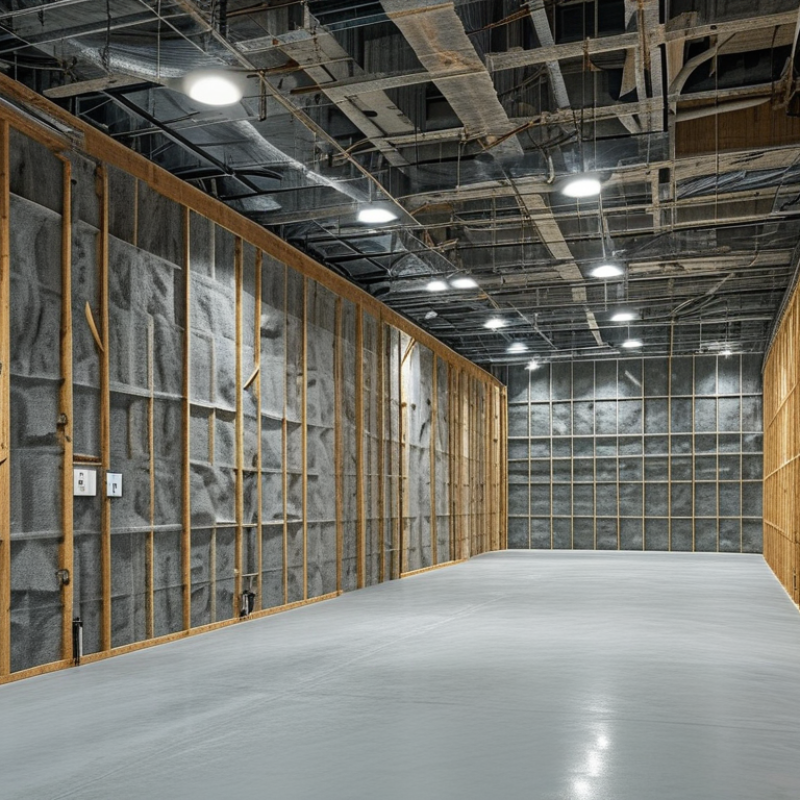
In walls, installers place rock wool between timber or metal studs. A snug fit is important, but excessive compression can reduce its effectiveness. Sealed outlets, joints, and service openings matter too. Sound often travels around insulation through gaps, doors, and lightweight framing. In ceilings, rock wool can sit between joists or above a suspended ceiling. It helps reduce voices, equipment noise, and some airborne sound from rooms above. Resilient channels and separated layers can improve results further.
Floors use rock wool between joists to limit sound moving between levels. It may also support a floating floor system when the full assembly is designed correctly. Impact noise needs more than insulation alone. Soft floor finishes and resilient layers may be necessary. In HVAC systems, rock wool surrounds ducts or lines selected duct sections internally. It reduces airborne noise from fans and moving air, especially near mechanical rooms. Installers must protect the insulation from moisture and leave access for maintenance. Small errors are easy to overlook. Yet one open seam can weaken an otherwise well-designed acoustic system.
What Is Sound-Insulating Rock Wool Used For?
Rock wool is used to reduce airborne and structure-borne noise in wall cavities, ceilings, floor systems, and HVAC ductwork. The chart shows representative thickness ranges commonly used in building assemblies.
Interior partition walls and ceilings commonly use 50–100 mm batts, while floor systems often use 20–50 mm acoustic layers. HVAC duct insulation is typically 25–50 mm thick to reduce fan noise and airborne sound transmission. Actual specifications depend on the assembly, density, fire requirements, climate, and local building codes.
Values represent typical construction ranges, not guaranteed acoustic performance. Sound reduction also depends on airtightness, framing, surface layers, and installation quality.
How Do Fire Ratings Above 1,000°C Support Safer Acoustic Construction?
What Is Sound Insulating Rock Wool Used For?
How Do Fire Ratings Above 1,000°C Support Safer Acoustic Construction?
Sound insulating rock wool is used inside walls, ceilings, floors, and service enclosures. Its dense, fibrous structure absorbs airborne noise and reduces reverberation. In apartments, offices, schools, and recording rooms, it helps soften voices, machinery, and pipe noise. The material also fits around irregular cavities, where rigid boards may leave small acoustic gaps.
Fire performance adds a less visible safety layer. Some mineral wool products can withstand temperatures above 1,000°C without melting, depending on their composition and test method. This is not the same as a one-hour fire-resistance rating. The complete wall or ceiling assembly must be tested under standards such as EN 13501-1 or ASTM E119. Joints, fasteners, membranes, and penetrations can change the result.
That distinction matters. The National Fire Protection Association reported 3,670 civilian fire deaths and 13,250 civilian injuries in the United States during 2023. A non-combustible insulation layer may help limit heat transfer and slow fire spread through concealed cavities. It can also support compartmentation while occupants receive warnings and escape. Acoustic performance should not be treated as proof of fire safety. Designers need verified test reports, correct installation density, and sealed service openings. Small gaps matter. So does workmanship, sometimes more than expected.
Noise control also supports healthier buildings. The World Health Organization links excessive environmental noise with sleep disturbance and other health risks. Yet specifications often focus only on decibel values. A safer design considers sound absorption, fire exposure, moisture, and the tested assembly together.



 Environmental Building Board
 Fire-proof Board
 Sound Resistance
 Termite Resistance